The Difference Between KYB, KYC and Telecom Sender Verification
Telecom fraud has become more sophisticated, more automated, and far more expensive for operators, CPaaS providers, enterprises, and regulators alike. SMS phishing, impersonation attacks, spoofed sender IDs, and fraudulent business registrations are now common across global messaging ecosystems.
That creates a practical problem for telecom providers and enterprise messaging platforms: how do you verify that the organisation sending traffic is legitimate before messages ever reach subscribers?
This is where KYB, KYC, and telecom sender verification intersect. They are related, but they solve different parts of the trust and compliance chain.
For businesses operating in A2P messaging, RCS, voice, and enterprise communications, understanding the distinction matters commercially and operationally. Verification failures can lead to blocked traffic, higher fraud exposure, regulatory scrutiny, and damaged sender reputation.
As an Ofcom-regulated UK MNO established in 2006, Brand Assure operates within a telecom environment where identity validation, fraud prevention, and sender trust are becoming foundational requirements rather than optional controls.
Contents
- What Is KYC?
- What Is KYB?
- What Is Telecom Sender Verification?
- Why Telecom Verification Requires More Than Standard KYB
- How Sender Verification Works in Practice
- The Regulatory Pressure Behind Verification
- Why This Matters for Mobile Networks and CPaaS Providers
- KYB, KYC and Sender Verification Are Different Layers of Trust
- FAQ
What Is KYC?
KYC stands for Know Your Customer.
Traditionally associated with banking and financial services, KYC refers to the process of verifying the identity of an individual. The purpose is straightforward: prevent fraud, money laundering, impersonation, and criminal misuse of services.
Typical KYC checks include:
Government-issued identity verification
Address verification
Sanctions screening
Politically exposed person screening
Device and behavioural analysis
Fraud risk scoring
In telecom environments, KYC often applies to:
SIM registration
Consumer mobile accounts
Individual sender onboarding
Prepaid mobile services
Voice and messaging authentication
KYC focuses on people.
That distinction matters because most enterprise messaging fraud is no longer carried out by anonymous individuals acting directly. Instead, fraud increasingly operates through shell companies, fake brands, compromised corporate entities, or fraudulent business registrations.
That moves the problem beyond standard KYC.
What Is KYB?
KYB stands for Know Your Business.
Rather than verifying an individual person, KYB validates whether an organisation is legitimate, operational, and authorised to conduct business activity.
For telecom providers and enterprise messaging platforms, KYB has become critical because most A2P messaging traffic originates from businesses, platforms, SaaS companies, banks, retailers, logistics firms, or public sector organisations.
Standard KYB checks may include:
Company registration verification
Director validation
VAT registration checks
Business address verification
Domain ownership analysis
Corporate document review
Beneficial ownership screening
Financial risk indicators
Sanctions and watchlist screening
A proper KYB process helps identify.
Shell companies
Fraudulent entities
Synthetic businesses
Brand impersonation
High-risk industries
Disposable messaging operators
For telecom ecosystems, KYB acts as the first layer of sender trust.
But there is still a gap.
A company may exist legally while still abusing messaging infrastructure, impersonating brands, or attempting to distribute fraudulent traffic.
That is why telecom sender verification goes further than standard KYB processes alone.
What Is Telecom Sender Verification?
Telecom sender verification validates whether a business is authorised to send traffic using a particular brand, sender ID, number range, messaging campaign, or communications channel.
This is not just identity validation.
It is operational trust validation.
A sender verification framework may assess:
Whether a company legitimately owns a brand
Whether a sender ID matches the organisation
Whether domains align with messaging campaigns
Whether the business has a history of spam or abuse
Whether traffic patterns match expected behaviour
Whether the sender complies with telecom regulations
Whether messaging use cases are legitimate
Whether voice and SMS traffic are consistent with declared activity
In practice, telecom sender verification combines:
Verification LayerPurposeKYCVerify individual identityKYBVerify business legitimacySender verificationVerify telecom messaging authority and trust
This distinction is becoming increasingly important across:
A2P SMS
RCS Business Messaging
Voice authentication
Branded calling
Enterprise SIP communications
CPaaS onboarding
International messaging routes
The telecom industry has learned that identity alone is not enough.
Traffic behaviour matters.
Why Telecom Verification Requires More Than Standard KYB
A business can pass KYB checks and still present major telecom fraud risks.
That is one of the core challenges facing operators and enterprise messaging platforms in 2026.
Consider a common scenario:
A company is legally registered. Directors are verified. Corporate documents appear legitimate. The business passes standard onboarding checks.
Weeks later, the company begins sending:
SMS phishing campaigns
Fake delivery notifications
Impersonation traffic
Crypto investment scams
OTP interception attacks
Fraudulent banking alerts
Traditional KYB frameworks were not designed specifically for telecom traffic analysis.
Telecom sender verification introduces additional controls such as:
Behavioural Analysis
Traffic behaviour often exposes fraud faster than documentation checks.
Verification systems may analyse:
Message velocity
Geographic inconsistencies
Sudden traffic spikes
SIM farm indicators
Repeated template abuse
URL reputation
Destination anomalies
Brand and Domain Correlation
Sophisticated fraud frequently relies on brand impersonation.
Verification systems can assess whether:
Domains match corporate ownership
URLs align with known infrastructure
Sender IDs resemble legitimate brands
Websites were recently registered
DNS records appear suspicious
Telecom-Specific Risk Signals
Telecom environments expose indicators traditional KYB providers may never see.
Examples include:
SS7 signalling anomalies
SMS pumping indicators
Artificially inflated traffic patterns
Number spoofing attempts
Voice CLI manipulation
High-risk international routing paths
This is where telecom-grade verification becomes operationally valuable rather than simply compliance-focused.
How Sender Verification Works in Practice
Modern telecom sender verification platforms typically combine multiple intelligence sources rather than relying on a single validation method.
A layered approach may include:
Business Verification
The organisation itself is validated using:
Corporate registry databases
Government records
VAT databases
Director checks
Beneficial ownership screening
Identity Correlation
The platform validates whether:
Domains match the registered business
Email infrastructure aligns with company ownership
Sender IDs reflect legitimate brand usage
Digital presence appears authentic
Telecom Traffic Analysis
Traffic is monitored for suspicious indicators such as:
High complaint ratios
Abnormal delivery behaviour
Spam signatures
Short-lived traffic bursts
Unusual international routing
Repeated content fingerprinting
Risk Scoring
Modern platforms increasingly use weighted risk scoring models combining:
KYB outcomes
KYC outcomes
OSINT intelligence
Historical sender reputation
Traffic analytics
Regulatory risk indicators
This allows operators and CPaaS providers to apply configurable thresholds rather than relying on simple pass/fail onboarding decisions.
Brand Assure’s approach reflects this multi-source validation model, combining KYB, KYC, and OSINT scoring to help identify bad actors before they reach subscribers.
The Regulatory Pressure Behind Verification
Sender verification is no longer driven purely by fraud prevention.
Regulators increasingly expect telecom providers to demonstrate proactive anti-fraud controls.
Across global markets, operators face pressure related to:
SMS phishing prevention
Scam call reduction
Sender traceability
Traffic transparency
Consumer protection obligations
Know-your-customer enforcement
Anti-spoofing controls
In the UK, Ofcom has continued increasing scrutiny around scam communications, nuisance messaging, and caller authentication.
Internationally, frameworks such as:
GSMA fraud prevention guidance
A2P sender registration programmes
Branded calling frameworks
RCS verified sender models
Financial sector anti-phishing standards
are all pushing operators toward stronger sender verification models.
The direction of travel is clear.
Anonymous enterprise messaging is becoming commercially and regulatorily unacceptable.
Why This Matters for Mobile Networks and CPaaS Providers
For operators and CPaaS providers, sender verification affects more than fraud prevention alone.
It also impacts:
Route Quality
Poor sender controls damage overall messaging ecosystem quality.
Unchecked fraudulent traffic can lead to:
Higher filtering rates
Reduced delivery performance
Increased false positives
Carrier distrust
Brand reputation damage
Commercial Trust
Enterprise clients increasingly expect:
Verified sender environments
Protected brand identities
Reduced spoofing exposure
Better deliverability
Transparent onboarding controls
Regulatory Risk
Operators unable to demonstrate adequate anti-fraud controls may face:
Regulatory scrutiny
Compliance investigations
Reputation damage
Commercial disputes
Increased filtering pressure from partners
Network Efficiency
Fraudulent traffic creates operational overhead:
Spam investigations
Dispute management
Manual reviews
Traffic remediation
Customer complaints
Verification frameworks help reduce those operational burdens upstream.
KYB, KYC and Sender Verification Are Different Layers of Trust
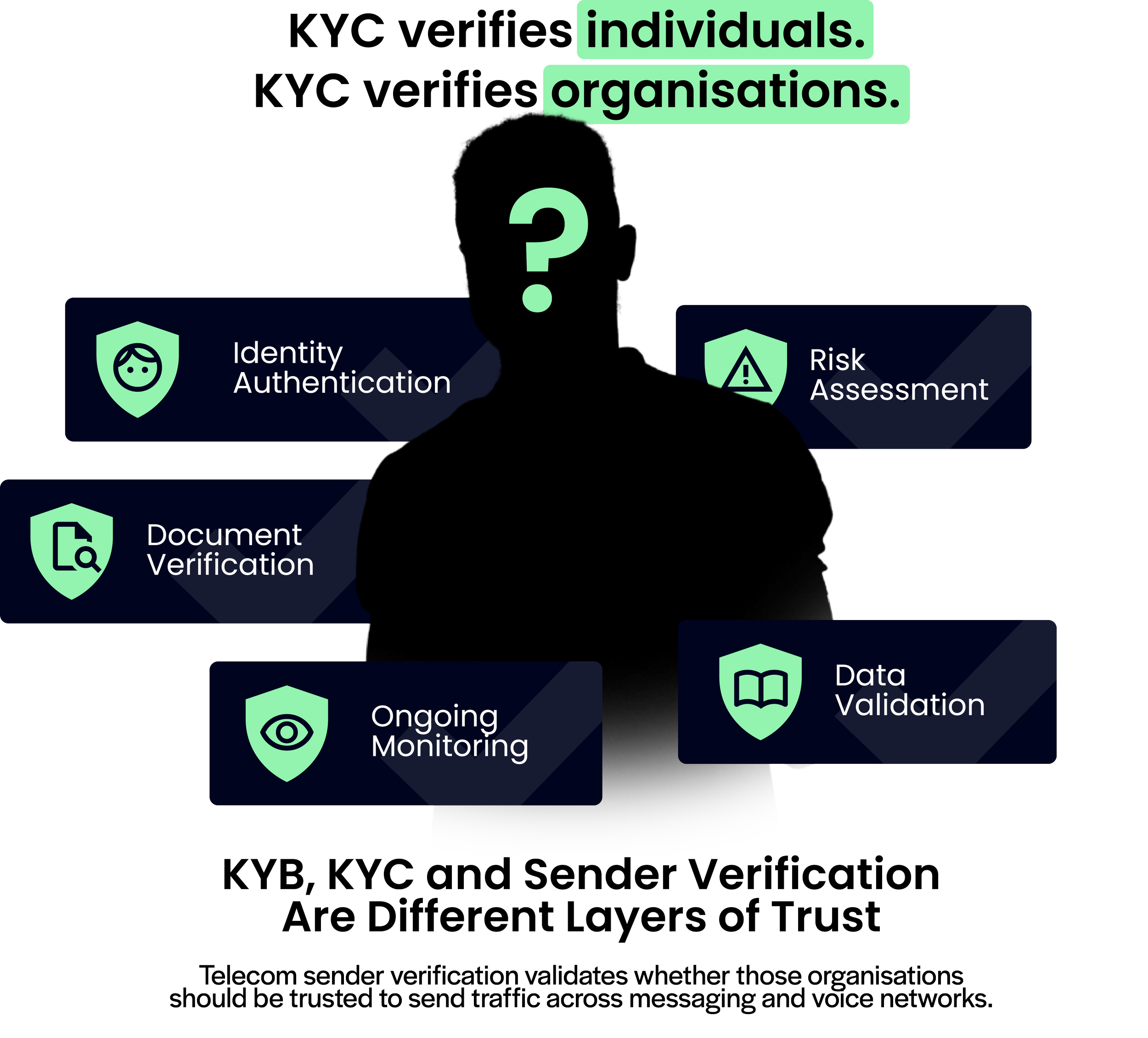
KYC verifies individuals.
KYB verifies organisations.
Telecom sender verification validates whether those organisations should be trusted to send traffic across messaging and voice networks.
That distinction matters because telecom fraud increasingly operates through legitimate-looking businesses rather than anonymous attackers.
For operators, CPaaS providers, enterprises, and regulators, modern trust frameworks require more than identity checks alone. They require telecom-aware validation capable of analysing behaviour, infrastructure, reputation, and traffic patterns together.
As enterprise messaging ecosystems continue evolving across SMS, RCS, and voice, sender verification is becoming part of core telecom infrastructure rather than a standalone compliance process.
For mobile networks and messaging providers, the challenge is no longer whether verification matters.
The challenge is how early fraudulent actors can be identified before trust, delivery quality, and subscriber safety are affected.
FAQs
-
KYC verifies the identity of an individual person, while KYB verifies the legitimacy of a business entity. Telecom providers often require both processes during onboarding because enterprise messaging traffic typically originates from organisations rather than consumers.
-
KYB helps telecom providers reduce fraud, spam, and impersonation risks by validating that businesses using messaging and voice services are legitimate organisations rather than shell companies or fraudulent operators.
-
Telecom sender verification confirms whether a business is authorised and trustworthy enough to send messaging or voice traffic using a particular brand, sender ID, phone number, or communications channel.
-
No. Sender verification builds on KYB rather than replacing it. KYB validates the business itself, while sender verification analyses telecom-specific trust indicators such as traffic behaviour, sender reputation, domain ownership, and fraud risk.
-
Operators face growing pressure to reduce phishing attacks, scam messaging, spoofed sender IDs, and fraudulent traffic. Stronger verification frameworks help protect subscribers, improve route quality, and support regulatory compliance.
-
Verified sender environments improve brand trust, message deliverability, fraud prevention, and customer confidence. They also reduce the risk of legitimate traffic being filtered alongside spam campaigns.